Drone pipeline inspection: which date counts as the patrol?
Drone pipeline inspection under PHMSA rules: patrol intervals, what PHMSA has said about drones, and why to log the flight date and the review date.
Drone pipeline inspection usually means flying the right-of-way patrol PHMSA requires: at least 26 times a year on hazardous liquid lines, and at least once, twice or four times a year on gas transmission lines. A drone can fly it. What PHMSA hasn't said is whether the patrol happened the day the drone flew or the day someone reviewed the images.
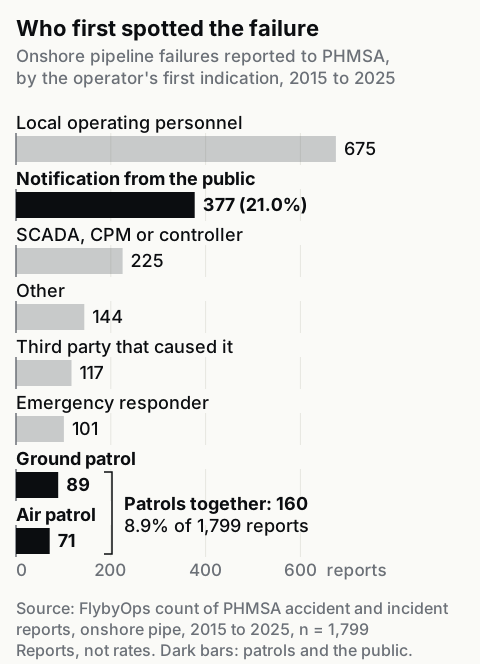
Until PHMSA decides, log both dates and plan each patrol so both fall inside the interval. The patrol is there to catch trouble early, and in FlybyOps' count of 1,799 onshore pipeline failures reported to PHMSA from 2015 through 2025, air and ground patrols were the first to spot 160 of them. Images nobody has looked at haven't spotted anything yet.
Flown Tuesday, reviewed Friday: which date is the patrol?
Gas transmission operators must have a patrol program "to observe surface conditions on and adjacent to the transmission line right-of-way for indications of leaks, construction activity, and other factors affecting safety and operation," and 49 CFR 192.705 lists the methods as "walking, driving, flying or other appropriate means of traversing the right-of-way." The hazardous liquid rule, 195.412(a), uses the same words. Neither mentions drones, and neither says when an image becomes a patrol.
PHMSA's clearest word on drones is a 2021 letter to Shell Pipeline. Interpretation PI-21-0006 says that "where aerial ROW inspection is appropriate, § 195.412(a) does not exclude drone (Unmanned Aerial System (UAS)) use as long as the images provided by the UAS have sufficient resolution to provide the necessary details of the surface conditions on and adjacent to each pipeline ROW." It covers hazardous liquid lines only, it didn't approve Shell's plan, and every law on flying drones still applies. Resolution has decided a case before: in a 2019 letter on satellite patrols, PHMSA said the satellite imagery it was shown "did not provide sufficient resolution."
PHMSA has tried to write drones into the rule before. A July 2025 direct final rule set out to do it, noting that PHMSA "has never clarified this explicitly in the regulation." PHMSA withdrew it on October 2, 2025, "due to the receipt of adverse comment." The April 2026 proposal tries again. Its proposed 192.705(c) reads "observation or imaging from walking, driving, flying via manned or unmanned aerial systems, satellite, or appropriate means for observing current surface conditions in the right-of-way," with a matching change to 195.412(a). PHMSA says it is "not proposing any revisions to the patrol frequencies or deadlines," and it asked commenters whether a deadline should run from the date images are collected, the date they're analyzed, or both. As of October 20, 2026, there's no final rule and the written regulation hasn't changed.
So log the capture date and the review date for every patrol, and work to whichever is later as your internal deadline. If PHMSA settles on the flight date, you're early. If it settles on the review date, you're on time. Write down your image detail standard too, meaning the zoom or ground resolution at which your reviewers can see a washout or fresh digging on your terrain.
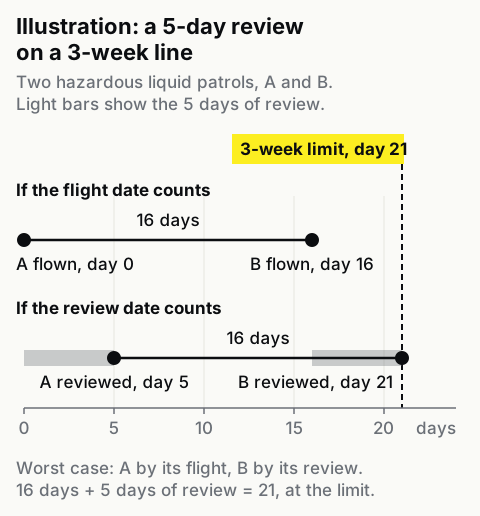
Here's what that does to a hazardous liquid schedule, where no two patrols can be more than 3 weeks apart. Say your team takes five days to review a patrol's images (an illustration, not a rule). Fly the next patrol no more than 16 days after the last, and you stay inside 3 weeks under either reading. The worst case counts the first patrol by its flight date and the next by its review date: 16 days plus 5 days of review is 21. Year end needs the same care. A patrol flown on December 29 and reviewed on January 3 counts toward one calendar year or the other, depending on which date PHMSA picks.
How often each pipeline has to be patrolled
Gas transmission intervals depend on class location and on whether the spot is a highway or railroad crossing. The gas figures are outer limits: 192.705(b) says the operator sets the actual frequency by the size of the line, operating pressures, class location, terrain, weather and other factors.
| Line (rule) | Longest gap (calendar-year minimum) | Where |
|---|---|---|
| Hazardous liquid and CO2 (195.412(a)) | 3 weeks (at least 26 a year) | Every right-of-way |
| Gas transmission, Class 1 and 2 (192.705(b)) | 7½ months (at least twice a year) | Highway and railroad crossings |
| Gas transmission, Class 1 and 2 (192.705(b)) | 15 months (at least once a year) | All other places |
| Gas transmission, Class 3 (192.705(b)) | 4½ months (at least four times a year) | Highway and railroad crossings |
| Gas transmission, Class 3 (192.705(b)) | 7½ months (at least twice a year) | All other places |
| Gas transmission, Class 4 (192.705(b)) | 4½ months (at least four times a year) | Crossings and all other places |
Twenty-six a year averages out to one patrol every two weeks. The 3-week figure is the most any single gap can stretch. And there's a lot of right-of-way to cover: operators reported 228,242 miles of hazardous liquid and CO2 pipeline and 300,217 miles of gas transmission pipeline to PHMSA for 2025.
The leakage survey is a separate duty with its own clock. 49 CFR 192.706 requires transmission leakage surveys at intervals not exceeding 15 months, but at least once each calendar year, and more often for unodorized gas in Class 3 and 4 locations. A patrol still watches for signs of a leak (192.705(a) names them), but PHMSA's April 2026 proposal calls patrols "not primarily a leak-detection tool, which is addressed by separate requirements at §§ 192.706 and 192.723."
What a drone looks for, and the FAA approval it needs
The pipe is buried, so a patrol reads the ground above and beside it. Crews look for digging or heavy equipment near the line, erosion, washouts and subsidence, dead or stressed vegetation, new structures creeping onto the right-of-way, and damaged or missing line markers. A zoom camera covers most of that, a thermal camera adds temperature contrast, and some programs carry a methane sensor as well. Long corridors suit fixed-wing and VTOL aircraft.
Miles of right-of-way run far past what a pilot can see. 14 CFR 107.31 says the pilot must be able to see the drone throughout the flight, so a corridor program needs a 107.31 waiver (see BVLOS waivers and the wider Part 107 waiver process) or another FAA approval. Heavier aircraft take a different route: according to AATI and Chevron Pipe Line Company, the FAA granted a 44807 exemption and a 91.113 waiver for the AiRanger, a 220 lb fixed-wing drone with onboard detect-and-avoid, to patrol pipelines in California's San Joaquin Valley. Phoenix Air Unmanned reports flying 320 miles of pipeline patrol for Shell Pipeline in 7.6 flight hours with one VTOL fixed-wing drone in southern Louisiana, under its FAA BVLOS waiver. The FAA's proposed Part 108 BVLOS rule isn't final as of October 20, 2026.
Patrols spot about 1 in 11 reported failures. The public spots more.
FlybyOps counted PHMSA's accident and incident reports for failures on onshore pipe, valve sites included, from 2015 to 2025: 1,799 reports, 1,146 from hazardous liquid lines and 653 from gas transmission and gathering lines. Stations, tanks, terminals and offshore pipe are left out. Every report answers the question "What was the Operator's initial indication of the Failure?"
In FlybyOps' count of those 1,799 reports, an air patrol was the first indication on 71 and a ground patrol on 89, which makes 160 (8.9%). A member of the public was first on 377 (21.0%), more than twice as often. The operator's local operating personnel came first on 675, the control room (SCADA, CPM or the controller) on 225, and the third party that caused the failure on 117. Emergency responders were first on 101, and other indications on 144.
What patrols found first was mostly corrosion: 76 of the 160 patrol-found failures (47.5%) had corrosion as the cause. Digging near the line is one of the things a patrol watches for, yet of the 239 excavation-damage reports in the set, a patrol was the first indication on fewer than 50. Excavation damage is also deadly: PHMSA's April 2026 advisory bulletin counts "over 875 excavation-related pipeline incidents and accidents resulting in 40 fatalities, 166 serious injuries" since 2005.
PHMSA's form has no box for a drone, and the words drone, UAS or UAV appear in fewer than 50 report narratives from 2010 to 2025. These are reports, not rates: they show who noticed a failure first, and a patrol that catches a problem before anything is released leaves no report at all. Liquid and gas lines also report under slightly different criteria.
For a drone program, that's a race against the public, and the flight is only half of it. A drone patrol beats the passerby with a phone only if someone reviews its images first.
What each pipeline patrol record should hold
Gas transmission operators keep each patrol record for at least 5 years or until the next patrol is completed, whichever is longer. For hazardous liquid lines, 195.404(c)(3) keeps each inspection and test record for at least 2 years or until the next one is performed, whichever is longer, and on its plain reading that covers right-of-way patrols. The FAA side has its own rules, covered in our guides to how long to keep drone flight records and what BVLOS records hold.
Neither retention rule says what a patrol record has to contain. This is the list we'd keep for every drone patrol, starting with the two dates:
- Capture date and review date. Both, every time, until PHMSA picks one.
- The segment and its due date. Which line segment, its class location or crossing, and the interval deadline the patrol was flown against.
- Pilot, aircraft and approval. Who flew, which aircraft and payload, and the waiver or exemption behind the flight.
- The review. Who looked at the images, and the image detail standard they checked them against.
- Each finding until it closes. What was seen, what was done about it, and when.
Stephen Sutton, FlybyOps' CEO, describes flying BVLOS at scale as "much less about managing an individual flight and much more about managing the entire operational system behind it." Twenty-six patrols a year on a liquid line, each with two dates and its own findings, is that kind of system. FlybyOps already logs tens of thousands of flights a month, mostly BVLOS.
FlybyOps holds the flight side of the patrol record; the line map, segment asset records, leak detection and PHMSA reporting stay in your pipeline systems. Set up each line segment as a project or job, with its class location in the name or in an attached document. Flight plans assign the pilot and aircraft and can carry the waiver and other permits. Each flight log ties the flight to its project, pilot, aircraft, payload, weather and documents. Flight Sync records flights from supported DJI enterprise aircraft automatically through DJI Pilot 2, and flights on other aircraft are entered by hand.
Attach the review to the flight log as a report, and the append-only audit log shows who added it and when: the second date, sitting next to the first. A finding that needs follow-up can go in the risk register with an owner and a review date, or into incidents, where corrective actions are assigned to an owner, tracked and closed. The patrol procedure and the image detail standard sit in documents with version history.
See it in action
Bring your drone program onto one record
FlybyOps gives enterprise drone teams a single audit-grade record for projects, flights, equipment, risks and incidents. Start free — 14-day trial, no credit card.
Start free trial