FAA Order 7200.23E: what changes for drone teams
FAA Order JO 7200.23E takes effect October 31, 2026. What it changes for tower inspections, multi-day approvals, Class E airspace and COAs.
FAA Order JO 7200.23E is the rulebook FAA staff use to process drone airspace authorizations, waivers and certificates of authorization (COAs). It was issued on October 1, 2026, takes effect on October 31, 2026, and replaces the 2023 version, JO 7200.23D. Part 107 itself doesn't change. What changes is what the FAA will approve when you ask.
The order is written for the FAA's Service Centers, which process and sign most applications, so it reads like a desk manual (the full JO 7200.23E PDF is on the FAA's site). Five of its changes reach drone programs, and the table below shows which teams each one hits. The one we'd act on first is the new tower inspection authorization. It's the biggest grant in the order, and the order makes meeting its conditions the operator's responsibility, so a program that uses it should be able to show that each flight stayed inside them.
Which changes reach which program
| Change in JO 7200.23E | Who it reaches | What to do before October 31 |
|---|---|---|
| A new request type for inspecting towers and tall buildings above the facility map altitude | Telecom, broadcast and rooftop inspection teams in controlled airspace | Decide whether to ask for a wide-area or nationwide authorization, and set up how each flight under it gets recorded |
| Multi-day approvals at or below grid altitude, at LAANC-enabled airports, go to first responders only | Construction, site monitoring and survey teams working near LAANC airports | Plan one LAANC request per flying day on multi-week jobs |
| Written altitude rings for Class E surface areas around airports | Any team flying near smaller airports | Check which ring each site sits in |
| A see-and-avoid waiver, 14 CFR 91.113(b), folded into every Part 91 approval | Programs flying under a COA rather than Part 107 | Count back 60 business days from start dates and renewals |
| Part 107 operational waivers submitted through the Aviation Safety Hub (AVSHUB) | Any team holding or renewing a Part 107 waiver | Send the next waiver application through AVSHUB |
Tower and tall-building inspections above the grid
Paragraph 3-5 of the order creates a request for inspecting vertical structures: cell towers, communications towers and high-rise buildings. It excludes structures with horizontal spans, and names bridges and power lines as examples.
When a request meets the criteria, the Service Center can approve flight above the UAS facility map altitude without coordinating with the air traffic control facility. The authorization lists five conditions. The aircraft must:
- stay within a 100-foot radius of the structure and no more than 100 feet above its highest point
- stay within visual line of sight of the remote pilot in command
- stay out of the area within 2 nautical miles of any landing surface of an airport, heliport or seaplane base, unless a separate authorization covers it
- stay at least 500 feet below and 2,000 feet horizontally from clouds
- fly with at least 3 statute miles of visibility, as seen from the control station
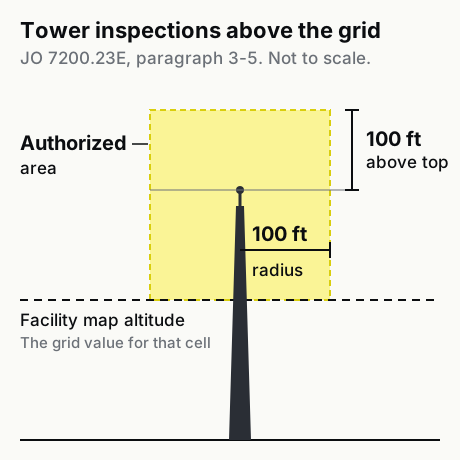
Three details shape how a program uses it. The request goes through FAADroneZone, even at airports where LAANC works. So the "no tower call" in some headlines still means filing a request and holding an authorization. It isn't a LAANC request, and it isn't LAANC further coordination. It can cover one site, a wide area, or the whole country for a company that asks. And it can run for up to 24 months from the date of issue. Airspace delegated to the Department of War for air traffic services is excluded.
Wind turbines aren't one of the listed structures. The order never mentions them, so don't plan a turbine inspection around this rule until a Service Center confirms it qualifies.
This doesn't replace the Part 107 altitude rule. Under 14 CFR 107.51(b), an aircraft may fly higher than 400 feet above ground if it stays within 400 feet of a structure and no more than 400 feet above its top. Paragraph 3-5 is narrower: it covers controlled airspace above the grid, inside 100 feet.
What the authorization leaves to you
A 24-month grant leaves most of the checking to the operator. For a specific-area authorization, the order says the Service Center doesn't have to verify that the operator meets the criteria, though it can do a quick check. If the request says the operator meets them, the conditions go into the authorization. Then the order is direct: "It is the proponent's responsibility to ensure they comply with the AA requirements."
A program flying dozens of towers under one authorization, with several pilots, should be able to show which authorization each flight used and that the flight stayed inside it. With each tower job, keep the authorization number and its expiry, the structure and its distance from the nearest landing surface, the pilot, and the weather at the time. Our drone cell tower inspection guide makes the same case: when each tower job carries the authorization it flew under, a carrier's question becomes a lookup.
Multi-day approvals at grid altitude: first responders only
The 2023 order let any operator with a defined project, such as a multi-day construction job with set dates and a set area, get one authorization for several days at grid altitude near a LAANC-enabled airport. JO 7200.23E removes that for everyone except first responders, and even then only when a multi-day approval brings a benefit, such as less processing time, workload or paperwork. Everyone else asking at or below the grid gets a single day, plus a note suggesting LAANC next time.
For a three-week site monitoring job beside a LAANC airport, that means a LAANC request for each flying day: a stack of authorizations where there used to be one. LAANC returns each in near real time, but each one still has to be filed against the right flight.
Above the grid, multi-day approvals at LAANC facilities are still possible. They need the facility manager's approval, and operators other than first responders also need a pre-defined project with a specified area and fixed start and end dates. The order also lets Service Centers add up to 14 days as a weather buffer, with the facility's approval. At airports without LAANC, an authorization can still run for up to 24 months and cover a wide area. That's the manual route covered in our guide to airspace authorization when LAANC isn't an option.
Class E surface areas get written altitude rings
Some airports have Class E airspace that starts at the surface, called a Class E surface area. The order says this type of request "was not addressed in previous versions of the order." Where the air traffic facility hasn't built its own facility map, Part 107 requests now follow fixed rings measured from the airport reference point:
| Distance from the airport reference point | Maximum altitude |
|---|---|
| Within 2 NM | Not authorized without prior coordination and approval from the facility |
| 2 to 3 NM | 100 feet AGL |
| 3 to 4 NM | 200 feet AGL |
| Beyond 4 NM | 400 feet AGL |
Every authorization in these areas also needs a cloud ceiling of at least 1,000 feet. Where the facility has published its own map, that map applies instead.
Programs flying under a COA
Every UAS approval under Part 91 must now include a waiver of the see-and-avoid rule, 14 CFR 91.113(b), for flights within visual line of sight as well as beyond it.
For line-of-sight work, the Service Center issues that waiver with the COA itself. Applications should go through the FAA's CAPS system at least 60 business days before operations start. BVLOS work takes a different route: email Flight Standards office AFS-750 for the 91.113(b) waiver and include a concept of operations. If AFS grants it, apply for the COA for airspace access. Renewals of both need the same 60 business days of notice. COA extensions are capped at 60 days, and an expired COA can't be extended.
Smaller changes
- Operations over moving vehicles, 14 CFR 107.145, joins the list of operational waivers an authorization can include without coordinating with the facility at grid altitude. The order says it was missing from the 2023 version.
- Individuals can't get approval for fixed flying sites under section 44809. Fixed sites and aviation events are for community-based organizations, and fixed site approvals now come as an airspace authorization instead of a letter of agreement.
Where each authorization lives
Before October 31, pick one place for every authorization you hold, so each flight under it points back to it. A spreadsheet of authorization numbers works until the second pilot flies the third tower.
FlybyOps can be that place. A flight plan can carry its permits and other supporting files, the flight log keeps them with the completed flight, and the documents area keeps version history and links each document to the work it supports. Weather is recorded with each flight. FlybyOps doesn't grant or guarantee an authorization. It keeps the record that shows which authorization a flight relied on.
See it in action
Bring your drone program onto one record
FlybyOps gives enterprise drone teams a single audit-grade record for projects, flights, equipment, risks and incidents. Start free — 14-day trial, no credit card.
Start free trial