What is a PDRA? EASA's five PDRAs and the UK's PDRA01
PDRA means pre-defined risk assessment. The EU has five from EASA; the UK has one, PDRA01. Their limits side by side, and what to keep after approval.
A PDRA, or pre-defined risk assessment, is a drone risk assessment the regulator has already carried out for a common type of operation. Instead of writing your own SORA, you show that your operation meets every condition in the PDRA's table, write an operations manual, and apply for an operational authorisation. It shortens the analysis, not the approval.
Which PDRA you mean depends on where you fly. In the EU there are five, published by EASA. In the UK there is one, the CAA's PDRA01, and the UK does not currently recognise EASA's five. (This is the aviation PDRA, not the drag racing series or the postdoc job.)
PDRA meaning: a risk assessment that is already done
EASA describes a PDRA as "an operational scenario for which EASA has already carried out the risk assessment". Each one is published as acceptable means of compliance (AMC2 to AMC6) to Article 11 of Regulation (EU) 2019/947, the article that sets out how risk is assessed in the Specific category. All five land on the same result: a final ground risk class of 3 and SAIL II.
That puts the PDRA in the middle of three routes into the Specific category:
- A standard scenario (STS-01 or STS-02) is a declaration. You submit it to your national authority and fly, but the drone must carry a C5 label for STS-01 or a C6 label for STS-02.
- A PDRA ends in an operational authorisation that your national aviation authority issues after reviewing your application. EASA says the process is "much simplified" compared with a full assessment.
- A full SORA is your own risk assessment for an operation nothing published covers. It is the most flexible route and the most work. Our SORA guide walks through it.
EASA PDRAs: the five tables
EASA's PDRA page lists five, and the letters split them into two families. The S family mirrors the two standard scenarios. The G family is generic, for common operations no standard scenario describes. In EASA's words, the typical operations are:
- PDRA-S01: agricultural works, short range cargo operations
- PDRA-S02: surveillance, agricultural works, short range cargo operations
- PDRA-G01: surveillance, long range cargo operations
- PDRA-G02: all range of operations
- PDRA-G03: linear inspections, agricultural works
Each one is a table of conditions. You go down it and declare compliance with every line, as part of your application for the authorisation. It's all or nothing: an operation that meets most conditions and makes up its own answer to one needs a different route.
EASA says S-01 and S-02 "cater for exactly the same operation of the EU STS, but they do not require using a drone bearing a C5 or C6 class label." That doesn't mean any drone will do. The tables still require either a C5 (S-01) or C6 (S-02) drone, or one that meets the technical requirements of Part 16 of the Annex to Regulation (EU) 2019/945 without the label. For a programme flying capable aircraft that were never class marked, that is often the practical way into work a standard scenario would otherwise cover.
It's still five. EASA says more PDRAs are under evaluation, and its page shows four from JARUS (the Joint Authorities for Rulemaking on Unmanned Systems), but none has been adopted. The five tables have also not yet been adapted to SORA 2.5, which became EU AMC through ED Decision 2025/018/R on 29 September 2025. EASA's explanatory note says JARUS is finalising a new PDRA format that EASA may adopt later.
S-01 carries most of the load. Of the 403 active PDRA authorisations an EASA presentation counted across the five as of 30 June 2024, 223 were under S-01.
PDRA drone operations: which table fits the job
The titles are a starting point. The limits in each table decide the fit: line of sight, aircraft size, height, range, ground area and airspace. Reading all five against the job takes an afternoon, and it's worth doing before anyone commissions a full SORA.
- Spraying, or a VLOS job on a site you control: S-01. It is VLOS at all times, over a controlled ground area, with a drone under 3 m, at up to 120 m (150 m only with a defined risk buffer).
- Short BVLOS runs over a controlled area: S-02. BVLOS to 1 km from the remote pilot, or 2 km with airspace observers, a drone under 25 kg including payload, and the drone in sight at launch and recovery.
- Longer BVLOS surveillance or survey in sparsely populated areas: G-01, in uncontrolled airspace or a segregated area. Without airspace observers the drone stays within 1 km of the remote pilot. With observers the range is not limited, as long as the drone stays within 1 km of the nearest one. Up to 150 m above the ground.
- Any range, if you can get the airspace: G-02. It applies only in reserved or segregated airspace, and the range is set by the direct C2 link.
- Corridor and near-structure work, such as power lines, pipelines and rail: G-03. BVLOS over sparsely populated areas, or over or within 15 m of a facility at the request of whoever is responsible for it, but only in what the table calls atypical airspace. That means segregated airspace, a flight geography below 30 m, or close to obstacles (within 30 m horizontally, and no more than 30 m above an obstacle under 20 m tall, or 15 m above a taller one).
Put in order, the check looks like this. Take the first table whose conditions you meet in full; anything left over needs a full SORA.
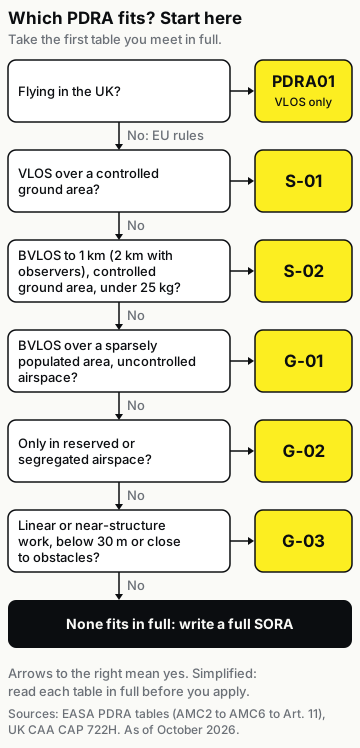
G-03 looks made for power line and pipeline programmes, but the airspace condition decides it. A corridor flown at 60 m in open airspace isn't a G-03 operation, however linear it is. Anything the tables don't cover, such as an unusual aircraft, a populated area they don't allow or a containment problem, sends you back to a full SORA.
PDRA vs PDRA01: the EU and UK side by side
The UK runs its own system. The CAA publishes the UK's pre-defined risk assessments in CAP 722H. That document lists one, UKPDRA01, and says plainly that PDRAs published by JARUS, EASA or any other body "are currently not recognised within the UK." An operator flying in both can't take an EASA PDRA into the UK, or PDRA01 into the EU.
| EASA PDRAs (EU) | UK PDRA01 | |
|---|---|---|
| Source | EASA, as AMC to Article 11 of Regulation (EU) 2019/947 | UK CAA, in CAP 722H |
| Number | Five: S-01, S-02, G-01, G-02, G-03 | One |
| Sight | S-01 VLOS; the other four BVLOS | VLOS only, within 500 m of the remote pilot |
| Aircraft | S-01, S-02: under 3 m, and S-02 under 25 kg; the G family: up to 3 m and 34 kJ typical kinetic energy | 250 g to under 25 kg |
| Height | S-01, S-02: 120 m (150 m with a risk buffer); G-01: 150 m; G-02, G-03: set by the airspace | 120 m (400 ft) |
| Where | Controlled ground areas or sparsely populated areas, depending on the table | Residential, commercial, industrial and recreational areas; 50 m from uninvolved people (30 m at take-off and landing) |
| Outcome | An operational authorisation from your national authority; validity and fees set nationally | An operational authorisation, £524 a year, valid 12 months |
Getting PDRA01 is quick. The CAA's online application takes about 15 minutes, no longer asks you to upload your operations manual, and aims to issue within 24 hours. The test comes later, in a compliance check. Our PDRA01 guide covers the application, the pilot certificates and that check step by step. BVLOS work in the UK has no PDRA and generally goes through a UK SORA.
What an EASA PDRA application involves
You fill in the PDRA table, write the operations manual and send both with the application form to the national aviation authority of the country where you are registered. EASA calls the table "a sort of checklist" for the procedures the manual has to contain, which is the right way to use it: each line of the table should point to the part of the manual that meets it.
The authority checks your submission against a document the regulator wrote, so the grounds for a refusal are visible in the table before you send anything. Timing and validity are national. Switzerland's FOCA, for example, asks for applications at least two months before the operation and issues authorisations valid for up to two years.
After approval: the records a PDRA expects
An operational authorisation describes the operation as you presented it. The conditions in the PDRA table become the conditions of your approval, and they bind the crew flying next spring as firmly as the person who filled in the form. Aircraft get replaced, pilots join, procedures change after an incident, and a programme that stops checking will eventually fly a job the authorisation doesn't cover without anyone deciding to.
Authorities expect the records to show the operation still matches. FOCA lists "maintaining the required documents, records and logbooks" among the operator's duties for the life of the authorisation, and an authorisation cannot be transferred to another operator. In practice that means keeping current, for every job flown under the PDRA:
- which aircraft flew, and that each still meets the table's technical conditions
- which remote pilots flew, and the competence the table asks of them
- the operations manual as it stands, and what changed and when
- the flight records for each job, tied to the authorisation they were flown under
- maintenance and any occurrences
In the UK, the CAA's check asks for evidence from your last three flights and gives you 28 calendar days to send it before the authorisation is suspended. The PDRA01 guide lists the pack.
Those records outlast the application, and they're what FlybyOps keeps. Flight logs for each job sync automatically from supported DJI controllers through Flight Sync and sit alongside the equipment and maintenance records, a risk register with mitigation owners and review dates, the manuals and approvals in a document vault, and an append-only audit log of who changed what. When the authority asks for evidence against the conditions you were approved on, it's in one place rather than spread across spreadsheets.
PDRA FAQ
Is a PDRA the same as a SORA?
No. A SORA is a risk assessment you carry out yourself for an operation no published scenario covers. A PDRA is one EASA has already completed, and you demonstrate compliance with it instead of repeating it.
Do I still need an operational authorisation with a PDRA?
Yes. A PDRA ends in an authorisation issued by your national aviation authority, unlike a standard scenario, which is declared.
Does a PDRA require a class marked drone?
No class label is required for S-01 or S-02, but the drone must meet the technical requirements of Part 16 of the Annex to Regulation (EU) 2019/945, or carry the C5 (S-01) or C6 (S-02) label. The G-family tables do not ask for a class label.
Is PDRA the same as PDRA01?
No. PDRA01 is the UK CAA's own pre-defined risk assessment, for VLOS flying in and around built-up areas. EASA's five PDRAs apply in the EU, and the UK does not currently recognise them.
Which PDRA suits infrastructure inspection work?
G-03 is written for linear inspections, but only in atypical airspace: segregated airspace, below 30 m, or close to the structure. Longer BVLOS survey over sparsely populated land usually fits G-01, and G-02 needs segregated airspace.
See it in action
Bring your drone program onto one record
FlybyOps gives enterprise drone teams a single audit-grade record for projects, flights, equipment, risks and incidents. Start free — 14-day trial, no credit card.
Start free trial