Drone facade inspection: what NYC and 3 other cities allow
Drone facade inspection under NYC's FISP rule: what a drone may do, DOB's Cycle 9 filing data, the NYPD permit, and how 3 other cities compare.
New York City's facade rule says "the use of drones ... does not eliminate the requirements for close-up inspections." So in New York the drone isn't the inspection. It's the survey that shows the inspector where to hang the scaffold for hands-on checks (the "drops"), and the record the next cycle starts from. And the record matters: 43% of the buildings that filed in Cycle 9 ended it SWARMP (safe for now, with repairs still needed), with conditions the next inspector has to find and check again. (San Francisco lets drones carry more of the visual work.)
So plan the flights around the scaffold work. Fly early enough for the photos to shape where the drops go, and file every photo against its elevation (which side of the building) and location so the next cycle's inspector can find the same spots.
What does NYC's facade rule say about drones?
NYC's Facade Inspection Safety Program (FISP, often called Local Law 11) covers buildings taller than six stories, except wall parts less than 12 inches from a neighboring building's wall. The rule, 1 RCNY 103-04, sets a five-year cycle. Cycle 10 began on February 21, 2025, and each building's filing window depends on the last digit of its block number.
The inspection is done by, or under the direct supervision of, a Qualified Exterior Wall Inspector (QEWI) the owner retains. The QEWI designs an inspection program for the specific building, methods included. A drone enters as one of those methods.
The physical work is fixed. Close-up inspections from scaffolding or another observation platform run at intervals of no more than 60 feet, from ground level to the top, with at least one scaffold drop on each wall that fronts a public right-of-way and one more close-up for every additional 60 feet of facade. The rule says "the QEWI shall determine the most deleterious locations," meaning the worst-condition spots, for them. Since the ninth cycle, cavity wall construction also needs probes, one along each close-up interval, at least in every odd-numbered cycle.
DOB's FISP FAQ says "Drones may be used to perform inspections, but do not replace the requirement for a close-up (hands on) inspection," and defines hands-on as the QEWI being able to touch the facade, sound it and remove loose material. It adds that "the legal use of the drone itself is outside of our jurisdiction." DOB's 2021 drone report goes further: "a drone does not have the capability to conduct required probes," and high resolution images "can still mask the extent of defects by flattening the viewpoint."
The same report says where drones help: they "could potentially be used to assist in the selection of the location of close-up inspections."
In a college bell tower survey, STRUCTURE magazine notes, the drone "cannot sound masonry to detect delaminations" and typically couldn't fly closer than 10 feet to the building.
That gives the drone three jobs in a FISP inspection:
- The survey. Every elevation photographed, including walls that won't get a drop. Thermal images are leads to check by hand, not findings (see our drone thermal inspection guide).
- Drop selection. The QEWI marks the worst-looking areas on the photos, and the scaffold goes there.
- The re-check. The drone revisits the locations last cycle's report flagged, so the QEWI can compare the same spot.
What do NYC's Cycle 9 filings show?
As of October 28, 2026, 13,332 buildings have at least one submitted filing in DOB's Cycle 9 facade data, by FlybyOps' count. At their first filing, 32% were Safe, 43% SWARMP and 25% Unsafe. At their latest filing, 49% were Safe, 43% SWARMP and 8% Unsafe.
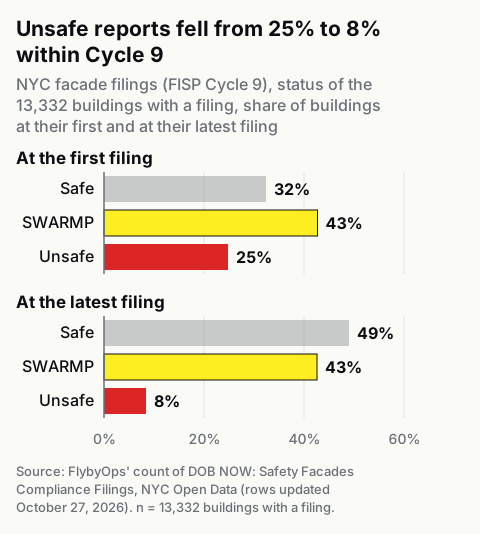
The drop in Unsafe comes from amended and subsequent reports that changed a building's status.
Safe, in the rule, means the facade will not become unsafe during the next five years. SWARMP (Safe With a Repair and Maintenance Program) is the status that carries over. Any condition reported as SWARMP and not corrected by the next inspection "must be reported as an unsafe condition," so the same condition at the same location can't be SWARMP two cycles running.
That turns the 43% into Cycle 10's starting list: for more than four in ten of the buildings that filed, the next QEWI begins with locations to find and check again.
Each building counts once, using its most recent submitted filing for the latest status. DOB's Cycle 9 data holds 16,400 buildings, and 3,068 of them (19%) have no submitted filing. That isn't a count of buildings out of compliance: DOB's own comments in the data mark some of them as demolished or not subject to the rule.
How do other cities' facade rules treat drones?
WJE lists 13 US cities with facade ordinances in effect. They differ on the question a drone operator cares about: whether a drone can carry part of the required inspection.
| City | Who it covers | What the rule says about drones or close-up work |
|---|---|---|
| New York | Buildings taller than six stories | Drones don't eliminate close-up inspections; scaffold drops at intervals of no more than 60 feet |
| Philadelphia | Six or more stories, or an appurtenance over 60 feet | Physical inspection from a scaffold or platform for a representative sample; drones are a supplemental method |
| San Francisco | Five or more stories, Type I to IV construction | Remote aerial vehicles may be used for General Inspections; comprehensive inspection is 100% visual and 25% tactile |
| Chicago | Buildings 80 feet or more | Close-up visual examination of all elevations; hands-on optional since a 2012 rule change, per NYC DOB's 2021 report |
San Francisco goes furthest. Its AB-110, adopted August 21, 2024, treats "3-D survey, remote aerial vehicles, and other non-traditional inspection methods" as "means and methods" the qualified professional may deploy for General Inspections. The tactile share of its comprehensive inspection, under ASTM E2270, still needs hands on the wall.
Philadelphia's L&I wants a first inspection within 10 years of completion, then one every five years. Its 2024 webinar lists "drone technology complying with FAA regulation" as a supplemental method.
Chicago's code asks for "a close-up visual examination of the condition of all elevations." NYC DOB's 2021 report says the hands-on part there has been optional since 2012, unless the inspection is more than ten months late or concerns are found.
What does it take to fly a facade in New York City?
NYC Administrative Code 10-126(c), as DOB's report quotes it, makes it unlawful, except in an emergency, to take off or land an aircraft anywhere in the city other than at places the Department of Transportation or the Port Authority designates. Since July 21, 2023, an NYPD rule has offered the way through. A permit "is required to take off or land an unmanned aircraft within New York City," with a few listed exceptions. The application carries FAA documents, proof of insurance and a data privacy policy.
Build the permit into the drop schedule. Apply at least 30 days before the first flight date, or 14 days for eligible repeat operators. One application covers up to five date, time and site combinations, up to 180 days ahead. A flight that captures images, video or audio, which every facade flight does, also needs notice to the community board and a notice posted within 100 feet of the take-off site at least 48 hours before.
Then the FAA. Under 14 CFR 107.39, a drone can't fly over a person unless that person is directly participating, under a covered structure or in a stationary vehicle, or the operation meets a Subpart D category. The sidewalk under the facade is where that matters. For tall buildings, 14 CFR 107.51(b) allows flight above 400 feet only within a 400-foot radius of a structure and no higher than 400 feet above its top, the same allowance cell tower crews work under. In controlled airspace, FAA Order JO 7200.23E has a request type for inspecting vertical structures, high-rise buildings included.
Plan for the aircraft losing its position near a building. In September 2018, a drone inspecting the windows of San Francisco's Millennium Tower lost its GPS signal and crashed. DOB's report also notes magnetic interference, mainly in Manhattan, that upsets a drone's inertial measurement unit. Put both on the preflight checklist for every facade job.
What is changing in NYC's facade program?
Local Law 49 of 2025, approved April 17, 2025 and in force since October 1, 2026, lets DOB set the cycle by rule anywhere from 6 to 12 years. The rule and DOB's facade page still say five years, and no new rule had been adopted as of October 28, 2026.
On March 6, 2026, in a push to take down sidewalk sheds, the mayor announced a six-year cycle and an abbreviated filing program for lower-risk, well-maintained buildings that "can lower hands-on inspection requirements to every 12 years." DOB's April 10 newsletter said DOB was working on the rules.
DOB's November 2025 proposals, as Thornton Tomasetti summarized them, included a pilot study testing "drones, photogrammetry, and computer vision" against hands-on inspections, and an abbreviated track in which "drone inspections would be required for taller buildings." Both are proposals, so today's flights still run on the current rule.
What does the next cycle's QEWI need from this cycle's flights?
Leave the next QEWI what they need to find every item again:
- Every SWARMP location keyed to its elevation and drop, with the photo, so the next inspector can shoot the same spot and compare.
- The drop locations the QEWI picked, and the survey photos that showed why.
- The QEWI's notes on each location, and the hands-on result for each thermal lead.
- The NYPD permit and the posted community notice, attached to the flights they covered.
Under all of that sit the usual flight log fields: date, pilot, aircraft and conditions. If a wall fails between cycles, those photos show what was seen and when, so drone footage needs a chain of custody from the day it's flown.
For firms running facade programs across many buildings and cycles, FlybyOps keeps this on the flight record. Each flight log is connected to its project, pilot, equipment and compliance documentation. It can carry permits, images, reports, risk assessments and customer documentation, so the NYPD permit and the facade photos sit on the flights they cover. Custom fields let a firm add the elevation, the drop ID and the SWARMP location to each record. Every plan includes an append-only audit log. When the next cycle comes around, the building's project shows what the last one flew and where.
Frequently asked questions
Who can fly the drone on a NYC facade inspection?
Every proposed operator on an NYPD take-off permit application needs an FAA Part 107 certificate, according to the NYPD's drone permit FAQ. The inspection itself is done by, or under the direct supervision of, the QEWI.
How much does a drone facade inspection cost in New York City?
Quotes depend on the building, and in NYC they come in addition to the scaffold drops, not instead of them. The city adds a fixed cost: the NYPD charges $150 per permit application, and flying without a permit carries penalties of $250, $500 or $1,000.
See it in action
Bring your drone program onto one record
FlybyOps gives enterprise drone teams a single audit-grade record for projects, flights, equipment, risks and incidents. Start free — 14-day trial, no credit card.
Start free trial