Drone inspection report template: avoid the reflight
A free drone inspection report template in PDF and Excel, built around what gets reports sent back: a required view missing with no reason, and no flight record.
A drone inspection report gets sent back for a reflight when a required view is missing and nobody wrote down why, or when a reviewer can't tell which flight, pilot and aircraft produced it. So a report that passes review needs three things: the findings, a coverage table, and the flight record behind them. The free template below has all three.
Why do drone inspection reports get sent back?
Usually because of the shot sheet, not the flying. In a November 2026 r/drones thread, a user with a full-time career in critical infrastructure inspection said that when inspectors are in a down period, they "will very highly critique the shot sheet and issue a reflight quickly if the smallest thing is missing or the pilot didn't notate why shots were missing (vegetation in the way, unsafe to fly, etc)."
That puts the fix before and during the flight, not in the office:
- Agree the required views before you fly. Write them down per asset with the asset owner: which components, which angles, and the standoff distance or image resolution they expect.
- Check coverage on site, before you pack up. A missing angle found at the truck is one more short flight. Found a week later, it's a second trip.
- Write a reason for every view you didn't get. "Not captured: gusts over the crew's limit" is an answer a reviewer can accept or schedule around. A blank looks like a miss.
Of three free sample drone inspection reports we opened in November 2026, none listed the required views or asked for the aircraft's serial number, and only one had a place to note what wasn't captured and why.
What does a coverage table look like?
Here's one filled in for a wind turbine. The views are an example; yours come from the list you agreed with the owner.
| Required view | Captured? | Image IDs | If not captured, why |
|---|---|---|---|
| Blade A, leading edge | Yes | IMG_0412 to 0438 | |
| Blade A, trailing edge | Yes | IMG_0439 to 0461 | |
| Blade A, pressure side | Yes | IMG_0462 to 0490 | |
| Blade A, suction side | Yes | IMG_0491 to 0517 | |
| Blade B, all four views | Yes | IMG_0518 to 0622 | |
| Blade C, suction side | No | None | Gusts over the crew's limit. Reflight booked |
| Nacelle and hub | Yes | IMG_0731 to 0748 | |
| Tower | Yes | IMG_0749 to 0770 |
A reviewer can check that at a glance: every view is either tied to a range of images or has a reason it isn't, and the one gap already has a plan. In a real report, blades B and C get four rows each, like blade A.
Who writes the findings?
Not always the pilot. In 2026, Fly-by Guys, the company behind FlybyOps, inspected 1,047 wind turbines by drone. On one of those campaigns, the client wanted the turbine images and video so it could analyze them in its own platform. What the operator handed over was the capture itself and proof that each turbine was covered, not a list of defects.
When your job does include findings, tie each one to the coverage table:
- Name the component and the image ID. "Leading edge erosion, blade A, 4 m from the tip, IMG_0427" lets the next person find it again.
- Rate it on a scale the owner has agreed to. The template carries an example: 1 Note, 2 Monitor, 3 Repair, 4 Urgent. Change the words and the response times to match the owner's own system.
- Say what should happen next, and leave the engineering judgment to whoever owns the asset.
Free drone inspection report template (PDF and Excel)
Both files are free, with no sign-up:
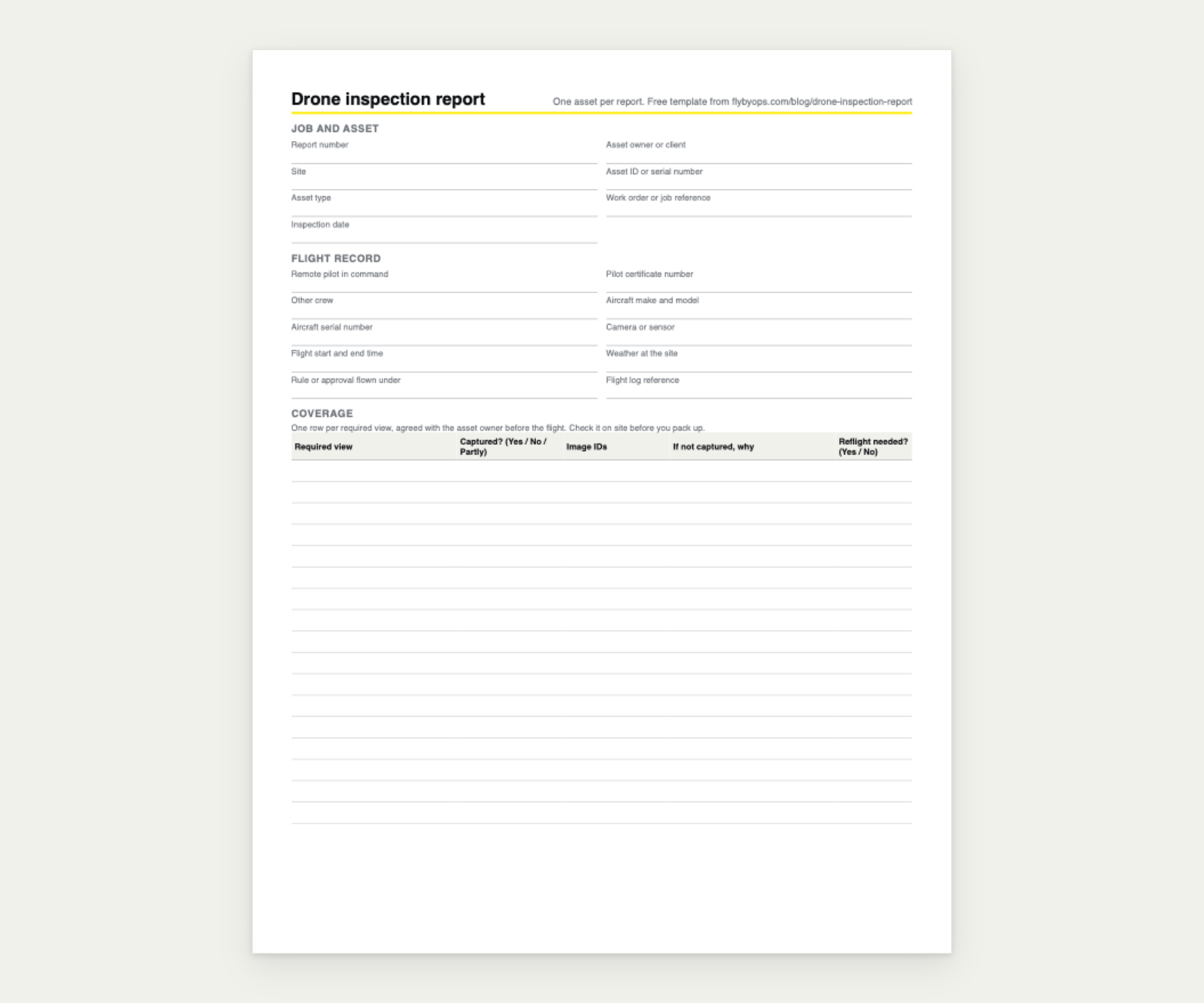
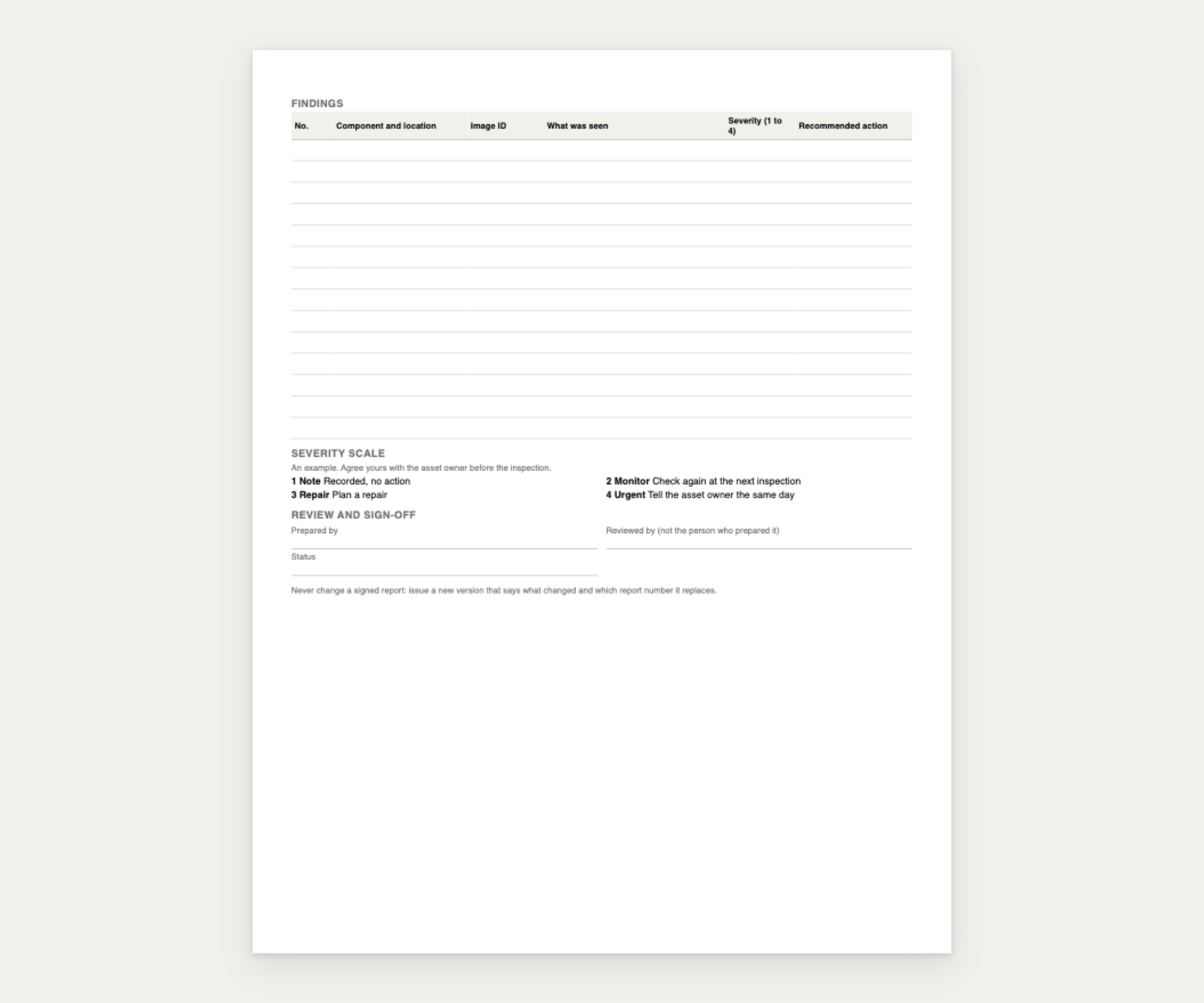
- Printable drone inspection report, PDF: two pages, one asset per report. Page 1 holds the job, the flight record and the coverage table. Page 2 holds findings, the severity scale and sign-off.
- Excel workbook (.xlsx): the same sections across Report, Coverage and Findings sheets, with drop-down lists for captured, reflight and severity, and a Read me sheet with the five steps.
What should the flight record and sign-off hold?
The flight record answers who flew, with what, and under which rule. The template asks for the remote pilot in command and their certificate number, other crew, the aircraft and its serial number, the camera or sensor, the flight times, the weather at the site, the rule or approval flown under (Part 107, a waiver number or a LAANC reference) and the flight log entry for the flight.
No single rule sets these fields for every drone inspection. But where a rule does define an inspection record, it asks the same kind of question. For process equipment at plants covered by OSHA's process safety rule, 29 CFR 1910.119(j)(4)(iv) requires "the date of the inspection or test, the name of the person who performed the inspection or test, the serial number or other identifier of the equipment," what was done and the results. For bridges, the National Bridge Inspection Standards define the report as the document that "summarizes the bridge inspection findings, recommendations, and identifies the team leader responsible for the inspection and report."
Sign-off belongs to a second person. The bridge standards require quality control and quality assurance reviews "performed by personnel other than the individual who completed the original report." Fly-by Guys' wind turbine campaign ran the same way in FlybyOps: one job per turbine, holding its serial number, order number, turbine type, site, tower height and mapped flight area, and each inspection was submitted and then approved before the turbine counted as done. The template's last lines are for that: prepared by, reviewed by, and accepted or reflight needed.
In FlybyOps, the flight record already holds the pilot in command and crew, the aircraft and battery, the weather, the customer and the project reference. Attach the finished report to that flight log, and nobody has to ask which flight, pilot or aircraft produced it.
FAQ
Does the FAA require a drone inspection report?
No, not under Part 107. 14 CFR 107.7 has the remote pilot in command, owner or person at the controls make available, on request, any "document, record, or report required to be kept" under the FAA's regulations, but Part 107 sets no inspection report of its own for a standard operation. The FAA's advisory circular on Part 107 says owners and operators "may find recordkeeping to be beneficial." A report can be required by the asset's own rules, such as the bridge standards or OSHA's process safety rule, and by your contract with the asset owner.
Can a drone inspection replace a hands-on inspection?
Not for bridges, on its own. The Federal Highway Administration's 2019 tech brief on drones in bridge inspection says they "are not intended to replace bridge inspectors, but rather can be used as a tool to supplement the information available to inspectors and bridge owners." Other asset types follow their owner's inspection program, so check what it accepts before you plan the flight.
See it in action
Bring your drone program onto one record
FlybyOps gives enterprise drone teams a single audit-grade record for projects, flights, equipment, risks and incidents. Start free — 14-day trial, no credit card.
Start free trial