FAA Part 108: is it final, and what happens to your waiver?
FAA Part 108 isn't final yet. What the proposed BVLOS rule asks of a drone program, and what it would mean for the Part 107 waivers already issued.
FAA Part 108 is the proposed rule that would let drone operators fly beyond visual line of sight (BVLOS) routinely, without a case-by-case waiver. The approval would belong to the organization, as an FAA permit or certificate, not to an individual pilot. As of October 21, 2026, it is still a proposal: no final rule has been published.
That matters most to programs already flying BVLOS on a Part 107 waiver. The proposal closes that route without saying what happens to the waivers already issued, and most waivers of the line of sight rule on the FAA's list run to 2028 or later. The work for this year is knowing when each waiver expires and keeping the records Part 108 names.
Is Part 108 final yet?
No. The FAA and TSA published the proposal on August 7, 2025, as a notice of proposed rulemaking (Docket FAA-2025-1908), and no final rule has followed.
Two deadlines frame the wait. The June 2025 executive order on drones asked for a final rule "within 240 days", which was February 1, 2026. That date has passed. The deadline Congress set in 49 U.S.C. 44811 is "not later than 16 months after publishing the proposed rule", which is December 7, 2026. Trade press, including Commercial UAV News, reports that the White House's regulatory review office (OIRA) received the final rule on July 10, 2026. TSA's September 2026 notice on BVLOS security still calls its own final rule "forthcoming".
So there's no release date to plan around yet. December 7 is a deadline for publishing a final rule, not for when it would take effect.
What is the difference between Part 107 and Part 108?
Part 107 stays. It still covers flying with the drone in sight, and proposed § 108.1 says Part 108 doesn't apply to operations under Part 107. For a BVLOS program, though, nearly every row below changes:
| Part 108 as proposed | Part 107 today | |
|---|---|---|
| Who is approved | The operator holds a permit or certificate (§ 108.100) | The remote pilot holds a certificate; BVLOS needs a waiver of § 107.31 |
| How BVLOS is approved | The permit or certificate, plus FAA approval of each area of operations (§ 108.165) | A waiver, case by case |
| People | An operations supervisor and flight coordinators, with no airman certificate required | A remote pilot in command with a remote pilot certificate |
| Aircraft | Up to 1,320 lb, 25 ft wingspan and 87 knots (§ 108.805) | Under 55 lb |
| Records | A set list of records with retention periods (§ 108.40) and regular reports (§ 108.45) | Show required records on request (§ 107.7), report serious injury or damage over $500 within 10 days (§ 107.9), plus whatever the waiver's conditions add |
The Part 107 recordkeeping guide covers what Part 107 asks for today, and the Part 107 waiver guide covers the waiver itself.
Is there a Part 108 drone license?
No. Part 108 doesn't create a new pilot license. The FAA's fact sheet says of the two new roles: "Neither position would require holding an FAA-issued airman or remote pilot certificate." The organization trains its own people instead, on 19 general subjects and 12 specific to the make and model, repeated every 24 calendar months (§ 108.315).
What the organization applies for is one of two approvals.
A permit covers lower-risk work. It lasts 24 months, can be renewed up to 120 days early, and an operator holds one per type of operation. Inspection work falls under the aerial surveying permit, which § 108.450 covers: "photography, videography, mapping, inspecting, or patrolling", with three limits: fewer than 25 active aircraft, no more than 110 lb including anything carried, and population density Category 3 or lower (§ 108.185 sorts areas into five categories by how many people live nearby, 5 being the densest).
A certificate has no fixed end date and covers the bigger operations: surveying with aircraft over 110 lb, and any flying in Category 4 areas, which § 108.185 reserves for certificate holders. It also brings a safety management system under Part 5 and an FAA-accepted training program. The FAA's own proposal-stage estimate for the SMS alone is $8,100 to $41,180 to set up and $4,730 to $42,580 a year.
For an inspection program, those are the limits to check. A utility with 25 or more active aircraft, aircraft over 110 lb, or work in Category 4 areas would need a certificate, not a permit.
Who has to be named under Part 108?
The proposal names roles, not job titles, so each program decides who fills them:
- Operations supervisor. Every operator needs at least one, "directly responsible for, and is the final authority as to, the safe and secure operation" of the aircraft in their charge (§ 108.120(d)). The FAA has to be told within 10 days when the person in the role changes (§ 108.305).
- Flight coordinator. Assigned before each flight when the manufacturer's instructions call for one. To qualify, a coordinator needs 5 hours on the specific make and model under supervision, then 5 hours in the last 12 calendar months to stay current (§ 108.310). The default is one aircraft per coordinator. More than one needs a method the FAA accepts (§ 108.210).
- Covered persons. Supervisors, coordinators, and anyone with unescorted access to the aircraft or its cargo or access to its controls or flight path need a TSA security threat assessment (§ 108.335).
- Operations personnel. Limited to a 14-hour duty day and a 50-hour duty week (§ 108.330).
Infrastructure programs get one provision of their own. Proposed § 108.205 allows shielded operations, where no manned aircraft are expected, in "areas within 50 feet of powerlines and substations, railroad tracks, bridges, and pipelines, when permission from the infrastructure owner is obtained". A contractor flying for the owner needs that permission first. The power line and pipeline inspection guides cover how those programs fly today.
What records would Part 108 make you keep?
This is the part of the proposal a program would live with every day. Proposed § 108.40 lists the records and how long to keep them, for permit and certificate holders alike, and § 108.20 makes failing to produce one on request grounds to suspend the approval.
| Record | Keep for | What it holds |
|---|---|---|
| Aircraft time in service | Life of the aircraft | Total time in service and the status of life-limited parts |
| Flight records | At least 24 months | Date, time, duration, registration, type of operation, flight path with altitudes, the people assigned, any other landing location |
| Mechanical irregularities | At least 24 months | Each irregularity found and the corrective action |
| Maintenance and alterations | At least 24 months | Inspection status; for each job, what was done, when, by whom, and the return to service |
| Personnel | Employment plus 12 months | Name, qualifications, current duties and when they were assigned |
| Training | Employment plus 12 months | Job function, hire date, last training date, materials, provider, proof of a passed test |
| Duty and rest (certificate holders only) | 3 months | Shift times, rest before each duty period, hours on duty each day |
Section 108.45 adds the reports:
- Flight hours for each aircraft to the FAA, at least once a calendar month.
- The aircraft list, with registration and serial numbers, at least once every 12 calendar months.
- Interruptions, meaning an unplanned or precautionary landing or a route change for a mechanical problem, by the end of the 10th day of the following month.
- Security occurrences within 96 hours.
- Damage over $500 to property other than the drone, or a malfunction that takes the aircraft into an unauthorized area, within 10 days.
The company operations manual sits beside all of this. Section 108.135 requires it to be kept current and under revision control, and it goes in with the application. How these records look under a waiver today is in BVLOS records.
What happens to your Part 107 BVLOS waiver?
As proposed, the waiver route closes. Proposed § 107.1(b)(5) adds BVLOS flight to the operations Part 107 doesn't apply to, and the § 107.31 waiver entry in § 107.205(c) is removed. The FAA's explanation in the proposal is blunt about it: "Any relief sought should be done under the auspices of part 108."
What the proposal doesn't do is say what happens to a waiver that's still running. The regulatory text has no transition date and no grandfathering clause. The only guidance is one sentence in that explanation: operations under existing waivers and exemptions "would transition to the operations under part 108 when their exemptions expire, and a reasonable transition can occur." DLA Piper's summary of the comments says the proposal "fails to provide a clear mechanism" for waiver holders to move across.
That gap is bigger than it looks. FlybyOps counted the FAA's list of Part 107 waivers on October 21, 2026: 981 of the 2,259 waivers on it (43.4%) waive § 107.31, the visual line of sight rule, and about 770 organizations hold them. None has expired yet, most run about four years, and 853 of the 981 (87%) expire in 2028 or later: 220 in 2028, 356 in 2029 and 277 in 2030, against 24 this year and 104 in 2027.
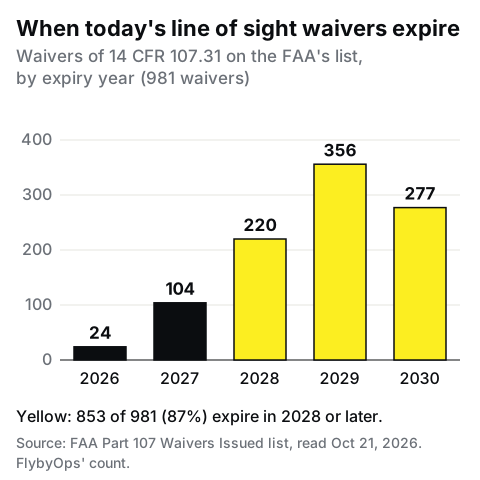
So for most programs, the waiver will still be running when a final rule arrives, and the final rule's transition terms are the first thing to read. Until then, the BVLOS waivers guide covers getting and running one.
What could still change in the final rule?
The FAA received about 3,100 comments, and its January 2026 notice said more than half of them discussed right-of-way. That notice reopened comments until February 11, 2026, on right-of-way and electronic conspicuity (aircraft broadcasting their position) only. Besides the waiver transition, two parts have drawn objections:
- Right-of-way and shielded areas. As proposed, a Part 108 drone would have right-of-way over other aircraft except aircraft that are departing from or arriving at an airport or heliport, in Class B or C airspace, or in Category 5 areas, or that are broadcasting ADS-B Out or qualifying electronic conspicuity (proposed § 91.113(h)). AOPA's comment calls it "unwise to rely solely upon" that technology, and the agricultural aviators' association objects to shielded areas "wherein UAS do not have to yield right-of-way to any aircraft".
- Which aircraft qualify. Part 108 aircraft would need FAA airworthiness acceptance, and § 108.700 limits that to manufacturers in the US or a country with a bilateral airworthiness agreement. DJI says that would rule out "the vast bulk of drones in current use".
What should a drone program do before the final rule?
Start with the parts that should survive whatever the final text says. The FAA's own cost analysis notes that "to large extent, the proposed requirements reflect conditions in existing waivers and exemptions", so the roles and records are safe ground. Right-of-way, required onboard equipment and which aircraft qualify are the parts to wait for.
- Decide who would be the operations supervisor, and who covers when they're away.
- List every waiver with its expiry date, and whether the same work fits a permit or needs a certificate.
- Keep flight, maintenance, mechanical irregularity and training records in the shape § 108.40 describes, tied to the aircraft and the people.
- Put the operations manual under revision control.
Stephen Sutton, CEO of Flyby Guys, described the shift when FlybyOps was introduced: once a team runs "hundreds or potentially thousands of BVLOS flights", "It becomes much less about managing an individual flight and much more about managing the entire operational system behind it."
That operational record is what FlybyOps keeps, for tens of thousands of flights a month, most of them BVLOS. Flight logs are connected to projects, pilots, equipment and documents. DJI flights arrive through Flight Sync and count toward each aircraft's flight hours and maintenance schedules, and other makes are logged by hand. Each asset keeps its maintenance history, and incidents and risks sit alongside the flights for the same work. Documents such as the operations manual keep their version history, and an append-only audit log records the changes.
See it in action
Bring your drone program onto one record
FlybyOps gives enterprise drone teams a single audit-grade record for projects, flights, equipment, risks and incidents. Start free — 14-day trial, no credit card.
Start free trial